Robert Lowell, Setting the River on Fire by Kay Redfield Jamison
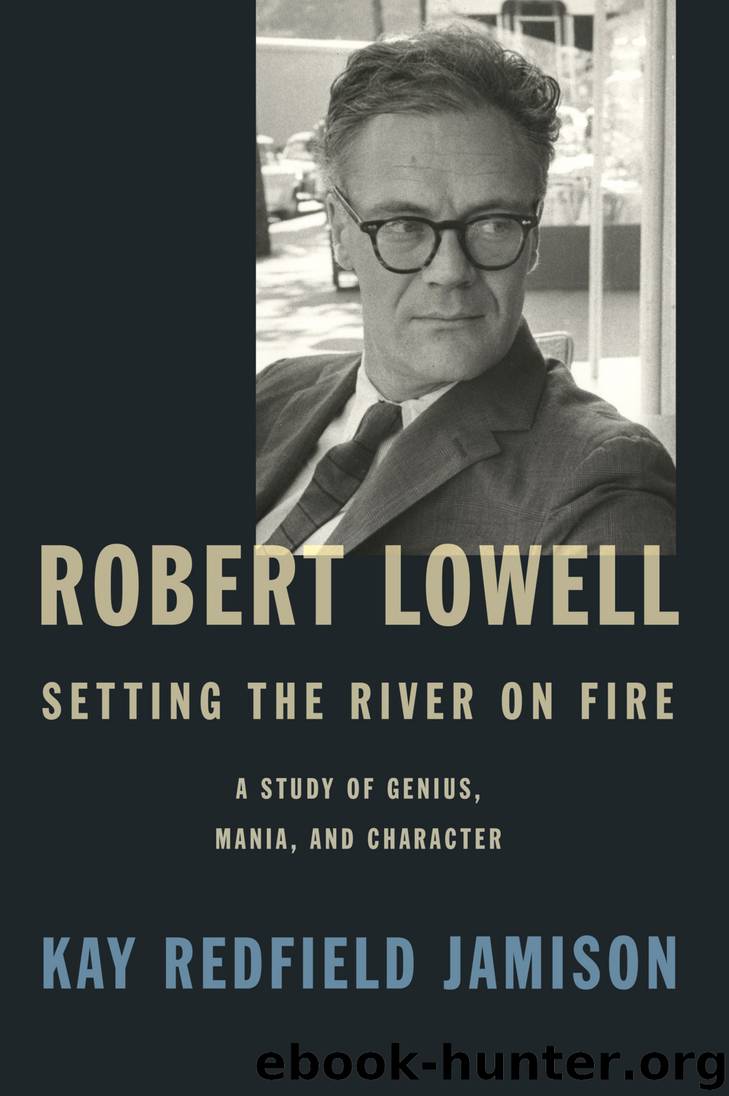
Author:Kay Redfield Jamison
Language: eng
Format: epub
Publisher: Knopf Doubleday Publishing Group
Published: 2017-02-28T05:00:00+00:00
Biographical Studies of Depression, Mania, and Suicide in Eminent Writers, Composers, and Artists
Credit 35
Adapted from K. R. Jamison, “Creativity in Manic-Depressive illness,” in F. K. Goodwin and K. R. Jamison, Manic-Depressive Illness: Bipolar Disorders and Recurrent Depression (New York: Oxford University Press, 2007).
A few years after Andreasen’s study of writers, I published a paper on forty-seven eminent British artists and writers I had studied while on sabbatical leave in England. They were selected on the basis of having won at least one of several major awards in their fields; for example, the painters and sculptors were Royal Academicians or Associates of the Royal Academy, an institution established by King George III in 1768 to honor a limited number of British artists and architects. Literary prizes used as criteria included the Queen’s Gold Medal for Poetry and other prestigious British awards in fiction, nonfiction, and poetry. At the time of my study, one-half of the poets had already been anthologized in The Oxford Book of Twentieth-Century English Verse; since then, most of the remaining poets have been included as well. The playwrights who participated in my study were recipients of the major awards in their field; for example, the New York Drama Critics’ Circle Award, the Tony Award, or the London Evening Standard Theatre Award.
My research focused not so much on mental illness in these artists and writers as on the influence of mood and seasonal changes on their creative work, but I also inquired whether they had been treated for depression or mania. A significant percentage, more than one-third, reported that they had. Because most people who meet the diagnostic criteria for mood disorders never seek treatment, this is likely a low estimate of the true rate of depression and mania in this group. Of artists and writers who had been treated for a mood disorder, three-quarters of them had been prescribed lithium or antidepressants and/or admitted to a hospital for psychiatric care. All of those who had been treated for mania were poets. One-half of the poets had been treated for bipolar illness or depression and, of the artistic groups, it was poets who most often reported that they had experienced extended periods of elated mood states. Most of them reported that their intense moods were essential to their creative work.
Arnold Ludwig, a psychiatrist who had conducted a large biographical study of psychopathology in eminent scientists, artists, writers, and military and civic leaders, then turned to the study of living writers. He compared fifty-nine women writers with fifty-nine women nonwriters who had been matched for age, educational level, and their fathers’ occupational status. He found that the writers in his study were four times more likely than the nonwriters to meet diagnostic criteria for depression, five times more likely to have attempted suicide, and six times more likely to meet diagnostic criteria for mania; these findings were consistent with those from his own earlier biographical research and the studies by Dr. Andreasen and me. These studies, like the biographical
Download
This site does not store any files on its server. We only index and link to content provided by other sites. Please contact the content providers to delete copyright contents if any and email us, we'll remove relevant links or contents immediately.
Should I Stay or Should I Go? by Ramani Durvasula(7652)
Why We Sleep: Unlocking the Power of Sleep and Dreams by Matthew Walker(6694)
Fear by Osho(4727)
Flow by Mihaly Csikszentmihalyi(4684)
Rising Strong by Brene Brown(4448)
Why We Sleep by Matthew Walker(4432)
The Hacking of the American Mind by Robert H. Lustig(4369)
How to Change Your Mind by Michael Pollan(4354)
Too Much and Not the Mood by Durga Chew-Bose(4334)
Lost Connections by Johann Hari(4169)
He's Just Not That Into You by Greg Behrendt & Liz Tuccillo(3888)
Evolve Your Brain by Joe Dispenza(3668)
The Courage to Be Disliked by Ichiro Kishimi & Fumitake Koga(3477)
Crazy Is My Superpower by A.J. Mendez Brooks(3394)
In Cold Blood by Truman Capote(3374)
Resisting Happiness by Matthew Kelly(3336)
What If This Were Enough? by Heather Havrilesky(3306)
The Book of Human Emotions by Tiffany Watt Smith(3290)
Descartes' Error by Antonio Damasio(3270)
